Online Casino Boom in India: What’s Driving the Surge in 2026
India’s online gambling market has entered a new phase in 2026. What was once a niche activity confined to a technically savvy minority has become a mainstream pastime for millions of players across the country. Platforms like TopX casino — offering INR accounts, UPI and PhonePe deposits, and Hindi-language support — reflect just how seriously offshore operators are now treating India as a priority market, rather than an afterthought.
A Market That Refuses to Stand Still
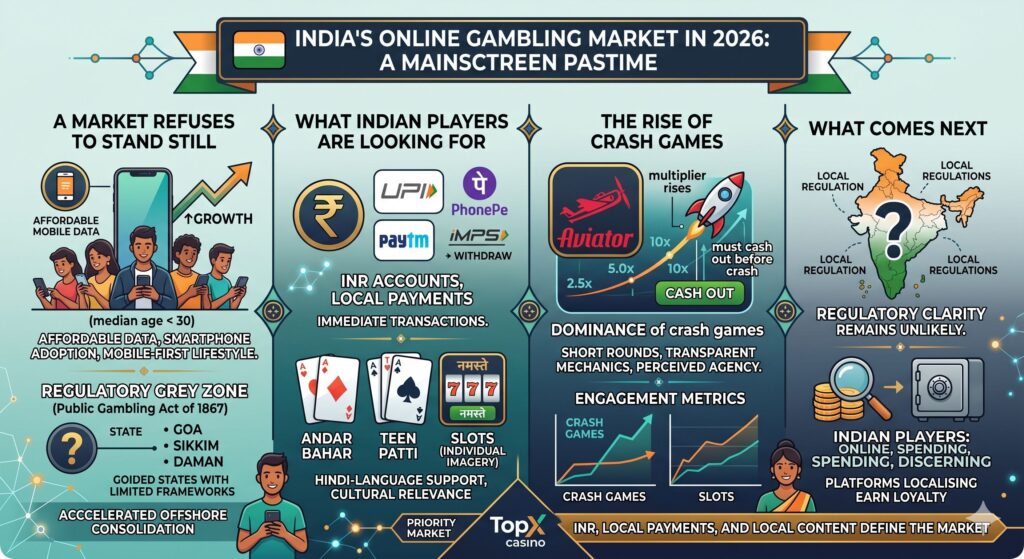
The structural conditions driving India’s online casino growth have been building for years. Affordable mobile data, near-universal smartphone adoption, and a population with a median age under 30 have created a user base that is large, digitally comfortable, and actively looking for entertainment options that fit a mobile-first lifestyle.
The regulatory environment, meanwhile, has not kept pace. India’s primary gambling legislation — the Public Gambling Act of 1867 — predates the internet by well over a century and makes no provision for online play. Individual states retain the authority to legislate in this area, and Goa, Sikkim, and Daman have each established limited legal frameworks for certain gambling formats. Online casinos, however, operate in a grey zone at the national level, which has left the field largely to offshore platforms licensed in jurisdictions such as Anjouan, Curaçao, or Malta.
That regulatory ambiguity has done little to slow growth. If anything, the absence of a domestic legal framework has accelerated the consolidation of Indian player activity on international platforms — particularly those that have made the effort to localise meaningfully.
What Indian Players Are Actually Looking For
The expectations of Indian casino users have grown considerably more specific over the past few years. Payment localisation is the clearest example. Players expect to transact in INR using tools already embedded in their daily lives — PhonePe, PayTM, UPI for deposits, and IMPS for withdrawals. Platforms that require international card payments or impose currency conversion have steadily lost ground to those that have built out proper local payment infrastructure.
Beyond payments, language and cultural relevance play a growing role. Hindi-language interfaces, responsive support, and game catalogues that include Andar Bahar, Teen Patti formats, and slots built around imagery familiar to Indian audiences have become genuine competitive factors rather than optional extras. Operators that treat these as secondary concerns are finding it increasingly difficult to retain Indian users against competitors that have made localisation a core part of their product.
The Rise of Crash Games
The clearest signal of where Indian online gambling taste is moving in 2026 is the dominance of crash games. Titles such as Aviator, JetX, and VORTEX — in which a multiplier rises until it crashes and players must cash out before it does — have built enormous audiences across India and broader South and Southeast Asia.
The format resonates for specific reasons. The rounds are short, the mechanics are transparent, and the experience carries a perception of player agency that traditional slots do not offer. For users who grew up with mobile gaming, crash titles feel intuitive in a way that five-reel slot machines simply do not. Platforms that have invested heavily in this category are seeing the results reflected in engagement metrics.
What Comes Next
Regulatory clarity at the national level remains unlikely in the short term. The state-by-state patchwork will continue to create uneven conditions, and the broader question of whether India moves toward a formalised domestic industry or maintains the current offshore-dominated model is one that legislators are still debating without obvious resolution.
What is not in doubt is the direction of demand. Indian players are online, they are spending, and they are becoming more discerning about where they do it. The platforms that understood this early — and built their products around INR, local payments, and locally relevant content — are the ones defining the market in 2026.