India’s Online Entertainment Economy: The Trends Defining 2026
India’s internet economy entered 2026 with more momentum than at any previous point in its history. The country now counts well over 800 million internet users, the overwhelming majority of whom access the web exclusively through a smartphone. That scale, combined with the maturity of UPI as a universal payment rail, has created conditions in which digital platforms of every category are competing for the same finite resource: the Indian user’s attention and discretionary spending. Platforms like TopX casino — supporting Hindi, accepting PhonePe, PayTM and UPI deposits from ₹300, and running as a PWA without requiring an app store download — represent a particular strand of that competition, one that has grown faster than most observers anticipated.
When Infrastructure Becomes Invisible
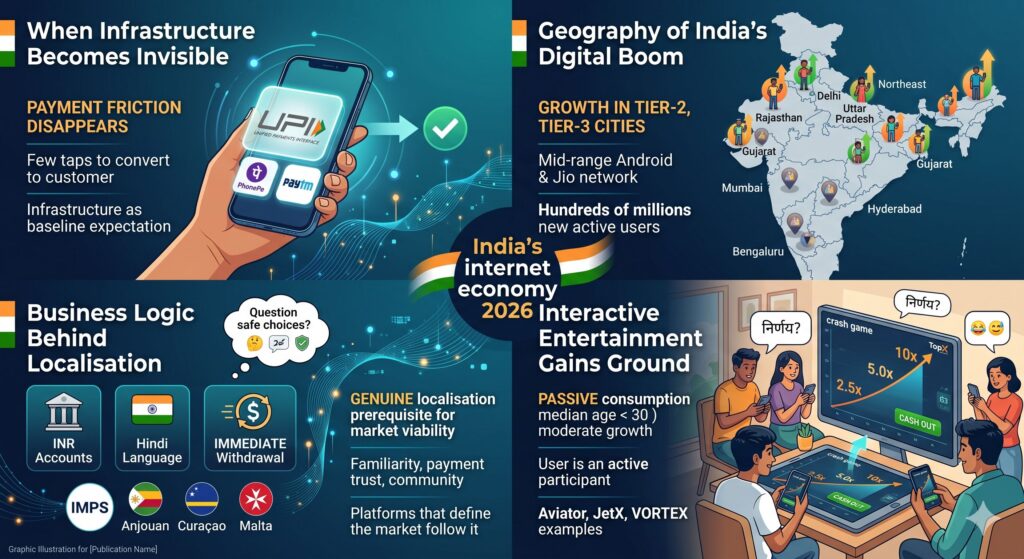
The most important thing that happened to India’s digital entertainment market over the past several years was not the launch of any single product — it was the point at which the underlying infrastructure stopped being something users had to think about. UPI reached that threshold some time ago. Paying for something online in India no longer requires retrieving a card, remembering a net banking password, or navigating an unfamiliar checkout flow. It requires a few taps on an app that is already open.
That invisibility has profound implications for digital platforms. When payment friction disappears, the barrier between a user encountering a product and a user becoming a paying customer collapses to almost nothing. The decision to try something new no longer carries a meaningful cost in time or effort. In practical terms, this means that product quality and word of mouth have become more important as acquisition drivers, while payment infrastructure has shifted from differentiator to baseline expectation.
The Geography of India’s Digital Boom
Discussions of India’s digital economy have historically centred on a handful of metros: Bengaluru, Mumbai, Delhi, Hyderabad. That framing is increasingly outdated. The growth story of 2026 is happening in tier-2 and tier-3 cities, in smaller towns across Uttar Pradesh, Rajasthan, Gujarat and the northeast, and among demographics that the early wave of Indian digital product development largely overlooked.
Affordable mid-range Android devices, Jio’s continued network expansion and the linguistic diversity of modern platforms — offering interfaces in Hindi alongside English — have brought hundreds of millions of previously peripheral users into the active digital economy. These users arrive with different habits, different content preferences and different spending patterns than the metro-centric early adopters who shaped the first generation of Indian internet products. Platforms that were built with this broader India in mind from the start have a structural advantage over those retrofitting their products for audiences they did not originally design for.
Interactive Entertainment and the Decline of Passive Consumption
One of the clearest trends in Indian digital entertainment in 2026 is the relative decline of purely passive consumption in favour of formats that demand participation. Streaming remains enormous, but its growth rate has moderated. The categories gaining share are those where the user is an active participant rather than an audience member.
Crash games — titles like Aviator, JetX and VORTEX, where a multiplier rises in real time and the player must decide when to exit — have become one of the most visible examples of this shift. The format is native to mobile, fits into short attention windows, and offers a sense of agency that passive video content cannot replicate. It also has a social layer: many titles display other players’ activity in real time, creating the kind of shared experience that drives community formation and sustained engagement.
The Business Logic Behind Localisation
For international platforms operating in India, 2026 has sharpened a lesson that was already becoming clear: genuine localisation is not a feature — it is a prerequisite for market viability. INR accounts, UPI and PhonePe integration, Hindi language support, and withdrawal infrastructure that processes in hours rather than days are not competitive advantages. They are the cost of entry.
The platforms that understood this early built user bases that are difficult for later entrants to displace. Brand recognition in India’s digital entertainment market is sticky in ways that pure product quality cannot fully explain — familiarity, payment trust, and community are the variables that keep users loyal when alternatives are available. In a market this large and this fast-moving, those intangibles are ultimately what separates the platforms that define the market from those that follow it.