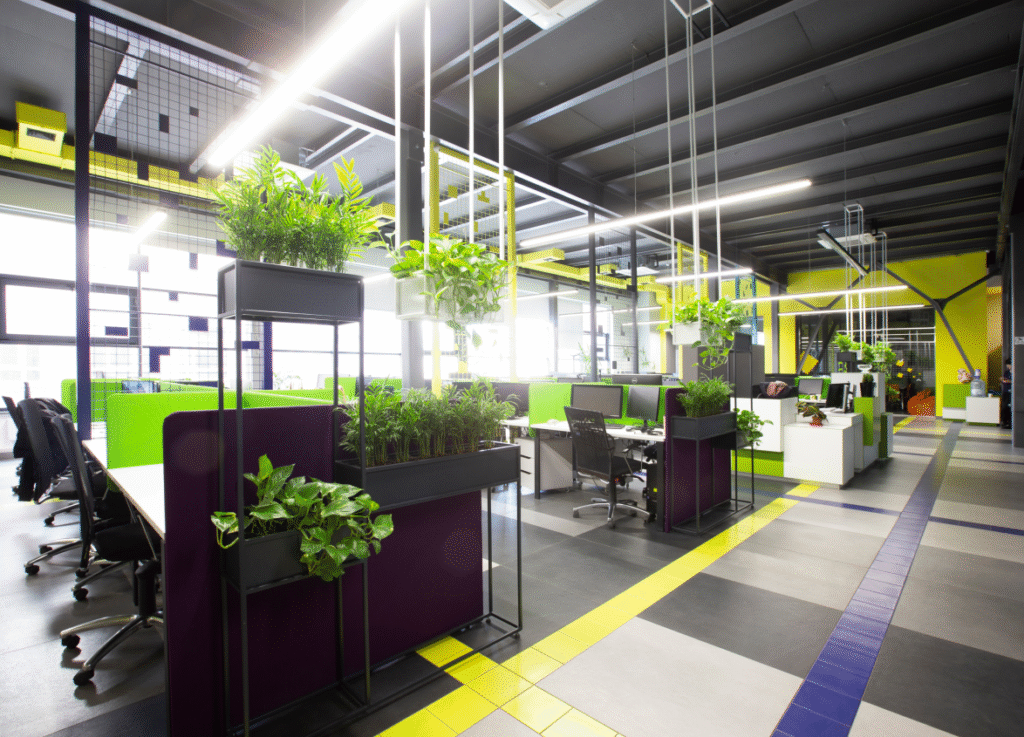
Walk into most newly set-up offices today, especially when companies evaluate office space in Noida, and the conversation around sustainability seems largely settled. Efficient lighting, better HVAC systems, and a green-certified building. On the surface, everything looks aligned.
But once operations begin, the discussion changes. What looked like a design decision start behaving like an operational challenge. Because sustainability, in practice, does not sit in what is installed. It shows up in how the office runs every day.
That is where EHS (Environmental, Health, and Safety) begins to matter more than expected.
What is EHS in Modern Office Spaces?
EHS in a workplace context refers to the systems and processes that manage environmental impact, employee health, and operational safety within an office.
In practical terms, it covers:
- How energy is consumed and monitored
- How waste is segregated and processed
- How indoor environments affect employee wellbeing
- How safety protocols are implemented and maintained
In many Grade A office spaces, EHS is not just a compliance layer. It operates closer to daily execution, influencing both efficiency and risk.
Office Space in Noida: Why EHS Is Becoming Operational, Not Optional
Across sectors like 62 and 16, and increasingly along the Noida Expressway, demand for office space in Noida has shifted from basic availability to operational readiness. The scale is different now. Larger teams. Higher occupancy. More dependence on shared infrastructure.
In such environments, small inefficiencies rarely stay small. A waste management gap does not affect just one team; it affects the floor. An overlooked safety issue does not remain theoretical; it becomes a risk. Energy usage, if not tracked consistently, begins to show up directly in operating costs. In large-scale office operations, EHS starts to move closer to the core strategy rather than sitting as a support function.
Where Sustainability Efforts Begin and Where They Tend to Weaken
Most organisations do not lack intent. That part is usually clear from the start. A company may move into office space in Sector 62 or explore office space in Sector 16, where infrastructure is already strong, and buildings are often designed with sustainability in mind. At that stage, everything appears aligned. Then operations settle in.
Over time, small gaps begin to surface. Waste segregation is followed initially, but it does not always hold. Energy usage gets reviewed, though not always with enough depth to catch inefficiencies early. Safety systems are in place, yet they are not revisited as consistently as they should be.
In some cases, vendors begin to drift from defined processes, especially when oversight becomes less frequent. None of these issues is critical on its own. But they rarely stay isolated. And over time, they begin to accumulate. That accumulation is what quietly defines how sustainable the office actually is.
The Gap Between A “Green Building” And A Sustainable Office
There is a tendency to assume that a well-designed building automatically ensures sustainability. It does not. Across office space in Noida Expressway and other emerging corridors, the difference often shows up after occupancy. Buildings are designed to perform efficiently, but they still depend on how systems are used and maintained.
In some offices, energy consumption is reviewed only at the end of the month, which makes early correction difficult. Indoor air quality is assumed to be stable without regular measurement. Waste is segregated at source but not always processed correctly beyond that stage. These are not structural problems. There are operational gaps. EHS sits exactly at this intersection, turning design intent into consistent execution.
A Practical Comparison: Similar Spaces, Different Outcomes
Consider two companies operating from comparable office setups in Sector 62. Both position themselves as sustainability focused. One invests more in visible improvements, workspace design, branding, and surface-level enhancements. The other focuses more on operational consistency.
Energy usage is reviewed regularly. Staff are trained on waste handling processes. Safety checks happen without prior notice. Vendors are monitored closely at the execution level. Nothing here is complex. But over time, the difference becomes visible. Both offices may look similar externally, yet internally, performance begins to diverge.
One start dealing with recurring inefficiencies and rising costs. The other operates with more predictability and fewer disruptions. The difference is not location or investment. It comes down to how consistently EHS is applied.
Sustainability, In Practice, Is Operational
Sustainability is often associated with infrastructure, modern layouts, certifications, or building design. These matter. But they are not enough on their own.
Sustainability shows up in how consistently systems are managed. How often are processes reviewed? How quickly risks are identified. How aligned vendors remain with operational standards. And how seriously safety is treated beyond basic compliance.
In fast-growing corridors like the Noida Expressway, where office space is scaling quickly, these factors become more visible. Gaps surface faster. So do their consequences.
The Role of Managed Office Environments
Managed office providers are starting to address these challenges in a more structured way. In many managed office spaces in Noida setups, particularly across sectors like 62, companies are opting for environments where EHS processes are already embedded into operations.
This typically includes standardised safety protocols, centralised waste management systems, ongoing energy monitoring, and structured compliance checks. It does not remove every challenge. But it reduces variability, and that improves operational consistency.
Leadership Influence on EHS Effectiveness
EHS systems are rarely limited by knowledge. More often, they depend on attention. When leadership remains engaged even at a high level, it creates accountability. Reviewing safety incidents, waste practices, or energy trends periodically can shift how teams behave. Without that involvement, EHS tends to become reactive. And reactive systems, over time, increase both cost and risk.
The Shift in How Office Spaces Are Being Evaluated
As companies continue to explore office space in Noida across Sector 62, Sector 16, and the Noida Expressway, the evaluation criteria are changing. The question is no longer just whether a building is green. It is increasingly about how effectively the office is being run.
That shift may seem subtle, but it changes how decisions are made. Sustainability is no longer defined by intent or certification alone. It depends on how consistently systems perform under real operating conditions.
Closing Perspective
For organisations evaluating office space in Noida today, EHS is no longer a secondary layer. It directly influences cost efficiency, operational stability, and long-term sustainability outcomes. Not through large, one-time decisions but through consistent execution, every day. And in most cases, that is where the real difference begins to show.